
Grading scale & standards
The standard
is public.
Published with no holding back, so you know exactly what to expect from your grading investment. Ten grades, the names you already know, one gold standard above them, and every threshold in writing.
The scale
Ten to one. Red to black.
Your card grade is a whole number, 1 to 10. No plus, minus or half points on the overall grade. The precision lives in the four subgrades, published on every label.
What each grade looks like
The grade, defined.
Each grade says what a card can still have and what rules it out. Centering minimums are listed where they apply; the four subgrade sections below say how we look.
- 10Flawless
An absolute perfect card. No flaws. Centering, corners, edges and surface each earned a 10. The gold label, and HGA Glass at no charge. Not a grade you can round up to.
- 10Gem Mint
A nearly perfect card: four sharp corners, crisp focus, full original gloss and no staining. A card can reach a 10 in one of three ways.
Centering: 55/45 or better on the front, 75/25 or better on the back.
- Clean: the surface, corners and edges have no defects.
- One light flaw: a single minor issue in one area, such as a light scratch, slight corner wear or a small printing imperfection, while everything else is clean.
- Trace flaws only: tiny flaws that are barely visible, as long as they don’t take away from the card’s overall look.
- 9Mint
A card in superb condition with only one minor flaw. A card can still get a 9 with:
Centering: 65/35 or better on the front, 90/10 or better on the back.
- One light flaw on the front, or in one area: a light scratch, a light print line, slight corner wear or slight edge wear.
- Light flaws on the back only: minor handling or printing marks on the back, such as a very slight wax stain or slightly off-white borders.
A card can’t get a 9 if it has any wrinkle or crease, even a tiny one, or if several small flaws add up to a bigger problem.
- 8Near Mint–Mint
Looks like a Mint 9 at first glance but shows a few small flaws up close. A card can still get an 8 with:
Centering: 70/30 or better on the front, 90/10 or better on the back.
- Moderate wear: a noticeable scratch, light fraying at one or two corners, or some edge wear, even in more than one area.
- Printing flaws: a moderate print line or another minor printing issue.
- Several light flaws: a few small issues, such as a very slight wax stain on the back or slightly off-white borders, as long as together they don’t hurt the card’s overall look.
- A tiny wrinkle: only one, and only if it’s barely visible.
A card can’t get an 8 if it has any crease, even a tiny one, or a wrinkle that’s more than barely visible.
- 7Near Mint
Clear signs of light handling, but the card still looks good overall. A card can still get a 7 with:
Centering: 75/25 or better on the front, 90/10 or better on the back.
- Heavier wear: a deep scratch, worn corners or worn edges.
- Minor print or focus issues: a small printing mark, or an image that’s a little off-register.
- Some loss of shine: a little gloss gone, most of the original finish kept.
- Back-only staining: a light wax stain on the back.
- A small wrinkle or tiny crease: a light wrinkle, or a crease that’s barely visible.
A card can’t get a 7 if it has a wrinkle that’s easy to see, or any crease beyond the faintest.
- 6Excellent–Mint
Wear you can see, but still an attractive card. A card can still get a 6 with:
Centering: no minimum. A card at 75.1/24.9 or worse on the front lands at 6 or below on centering alone.
- Visible wear: a faint scratch, some surface wear, corners that have started to round, a hard corner ding, or chipping and small nicks along the edges.
- Noticeable print or focus issues: a heavy print line, another clear printing flaw, or an image that’s slightly off-register.
- Faded finish: some loss of the original gloss, or borders starting to turn off-white.
- Back-only staining: a minor wax stain on the back.
- A moderate wrinkle or tiny crease: a wrinkle you can easily see, or a crease that’s barely visible.
A card can’t get a 6 if it has a heavy wrinkle or any crease beyond the faintest.
- 5Excellent
Clear wear, but the card still displays well. A card can still get a 5 with:
- Rounding corners: corners that have started to round, or one corner that’s badly crushed.
- Edge wear: small chips along the edges, or an edge that has split.
- Surface wear: a few light scratches, or surface wear and printing flaws that are easy to spot.
- Faded finish: gloss that’s clearly dulled, or borders turning off-white.
- Focus issues: an image that’s slightly off-register.
- Heavy wrinkle or moderate crease: a noticeable wrinkle, or a crease you can clearly see.
A card can’t get a 5 if it has a deep crease, peeling surface layers, or a spot where part of the surface is missing.
- 4Very Good–Excellent
Wear that’s easy to see, but the card still has some eye appeal. A card can still get a 4 with:
- Rounded corners: corners that are clearly rounded.
- Surface wear: light scuffs or scratches, surface wear that’s noticeable but not heavy, or a spot where part of the surface is missing.
- Peeling: surface layers that have started to peel.
- Faded finish: gloss that’s partly worn off, or borders that are off-white.
- A light crease: a crease you can see.
A card can’t get a 4 if it has a deep crease.
- 3Very Good
Heavy wear, but the card is still whole and easy to recognize. A card can still get a 3 with:
- Rounded corners: clear rounding, though not extreme.
- Worn surface and edges: visible surface wear, scuffs or scratches, and edges that are clearly worn.
- Faded finish: most of the original gloss gone; borders may be yellowed or discolored.
- Print and focus issues: printing flaws, or an image that’s noticeably off-register.
- Stains: a light stain on the front, or a heavier wax stain on the back.
- A deep crease: even a heavy crease is allowed.
- Several major flaws together: serious damage in more than one area at the same time.
- 2Good
Well-worn, and the damage is obvious. A card can still get a 2 with:
- Well-rounded corners: rounding that’s clearly advanced.
- Obvious surface wear: scratches, scuffs, light stains, or chipped color on the front.
- Several creases or wrinkles: more than one serious crease or wrinkle across the card.
- No shine left: the original gloss may be gone entirely, and the card may be heavily discolored.
- Weakened structure: serious damage in several areas that leaves the card fragile.
- 1Poor
The lowest grade. Heavily damaged, with almost no eye appeal left. A card gets a 1 when it has:
- Missing pieces: one or two small pieces of the card are gone.
- Deep creases: creases so heavy they nearly break through the card.
- Heavy damage all over: badly worn surface, corners and edges.
- Heavy dirt or discoloration: so much that it may be hard to tell what the card shows.
- Warping or other major damage: the card is bent out of shape or damaged in another serious way.
Graded so it is housed, recorded and protected.
- AAuthentic
No numerical grade. The card has been examined and deemed real and unaltered by HGA, and is housed with an Authentic label.
Altered cards are not authenticated or encapsulated by HGA. Any sign of trimming, recoloring, repair or cleaning sends the card to our authentication team before it gets a grade.
Every card is graded to the standard in effect on the day it is graded. The card grade is set from the four subgrades; the autograph, where present, is graded on its own and never lowers the card.
Subgrade 1 · Centering
Measured, not guessed.
We use a digital centering tool to measure each card's borders on the front and the back, and our graders are trained to confirm those measurements by hand. Because centering comes from how the card was cut at the factory, it carries extra weight and can limit a card's overall grade, however clean the rest of the card is.
| Front · measurement | Centering grade |
|---|---|
| 50.0 / 50.0 through 55.0 / 45.0 | 10 |
| 55.1 / 44.9 through 59.9 / 40.1 Gem determination band | 9.5 |
| 60.0 / 40.0 through 65.0 / 35.0 | 9 |
| 65.1 / 34.9 through 70.0 / 30.0 | 8 |
| 70.1 / 29.9 through 75.0 / 25.0 | 7 |
| 75.1 / 24.9 or worse | 6 or lower |
| Back · measurement | Centering grade |
|---|---|
| 50.0 / 50.0 through 75.0 / 25.0 | 10 |
| 75.1 / 24.9 through 90.0 / 10.0 | 9 |
| 90.1 / 9.9 through 95.0 / 5.0 | 8 |
| 95.1 / 4.9 or worse | 7 or lower |
Subgrade 2 · Surface
Both faces, every mark.
We inspect the full surface of every card, front and back, under controlled lighting and magnification, and we tilt each card to catch flaws that don't show straight on. We look for two kinds of issues: flaws from the factory, like print lines, print spots and focus problems, and damage from handling, like scratches, scuffs, stains, dents, wrinkles and creases. Where a flaw sits matters too: a mark on the player or character counts for more than one in the background. Every finding is located on the card image in the Grade Report.
- 10
No defects on either face under magnification, or at most one trace flaw that is barely visible and takes nothing from the card. Full original gloss, no staining.
- 9
One light flaw on the front, such as a light scratch or a light print line, or light marks on the back only. No wrinkle or crease of any size.
- 8
A noticeable scratch, a moderate print line, or several light flaws that together don't hurt the look. At most one tiny wrinkle that's barely visible. No crease.
- 7
A deep scratch, a small printing mark or a slightly off-register image, a little gloss gone, a light wax stain on the back. A light wrinkle or a barely visible crease.
- 6
Surface wear you can see, a heavy print line or another clear printing flaw, some gloss loss or borders turning off-white. A wrinkle you can easily see, or a barely visible crease.
- 5
A few light scratches, or surface wear and printing flaws that are easy to spot. Gloss clearly dulled. A noticeable wrinkle or a crease you can clearly see. No peeling or missing surface.
- 4
Light scuffs or scratches, noticeable but not heavy wear, surface layers starting to peel, or a spot where part of the surface is missing. A crease you can see, but not a deep one.
- 3
Visible surface wear, printing flaws, a light stain on the front or a heavier wax stain on the back. Most of the gloss gone. A deep crease is allowed.
- 2
Obvious scratches, scuffs, light stains or chipped color on the front. More than one serious crease or wrinkle. The gloss may be gone entirely.
- 1
Creases so heavy they nearly break through, badly worn surface, heavy dirt or discoloration, warping, or a piece of the card missing.
Subgrade 3 · Corners
Eight corners, one at a time.
Every card gets a corner-by-corner inspection: all eight corners, four on the front and four on the back, under magnification. We look for rounding, fraying, dings, whitening and layers starting to separate. For each flaw we weigh how easy it is to see, how much of the corner it covers and how many corners it shows up on. Any sign of trimming or touched-up corners sends the card to our authentication team before it gets a grade.
- 10
All eight corners sharp, front and back, with nothing found under magnification.
- 9
Slight corner wear on one corner, the kind you find under magnification. Everything else sharp.
- 8
Light fraying or a touch of softness at one or two corners, visible on close inspection.
- 7
Worn corners you can see at arm's length, on more than one corner. Still not rounded.
- 6
Corners that have started to round, or one hard corner ding.
- 5
Rounding on more than one corner, or one corner that's badly crushed.
- 4
Corners clearly rounded, with fraying you can see.
- 3
Clear rounding on every corner, though not extreme.
- 2
Rounding that's clearly advanced, corners fraying or separating in layers.
- 1
Corners badly worn, torn, or with pieces missing.
Subgrade 4 · Edges
Four edges, end to end.
We inspect all four edges on both faces of every card, in the same order each time, checking each edge from end to end. Graders use a controlled light, a loupe and their fingertips, since some edge flaws are easier to feel than to see. We look for whitening, chipping, fraying, dents, peeling and discoloration, and weigh how visible each flaw is and how far it runs. We know the difference between damage and how a card left the factory: a slightly rough factory cut is noted, but doesn't count against the card the way wear does. Any sign an edge has been trimmed, repaired or chemically cleaned sends the card to review before it gets a grade.
- 10
Clean, smooth, fully colored edges on all four sides, front and back, under magnification.
- 9
Slight edge wear in one place, found only up close.
- 8
Some edge wear, even in more than one area, visible on close inspection.
- 7
Worn edges you can see at arm's length.
- 6
Chipping and small nicks along an edge.
- 5
Small chips along the edges, or an edge that has split.
- 4
Chipping you can see on more than one edge, with some color loss.
- 3
Edges clearly worn along their length, with fraying and color loss.
- 2
Heavily worn, chipped or notched edges on most sides.
- 1
Torn, broken or badly damaged edges.
Autograph
Graded free. On the label at 10.
Every autograph is authenticated first, then graded for strength, placement and condition. A 10 goes on the front label. Anything less stays in the Grade Report, off the label. It can only help the card, never hurt it.
Blind grading
The grader never knows whose card it is.
The Grade Report
The grade is the headline. The report is the story.
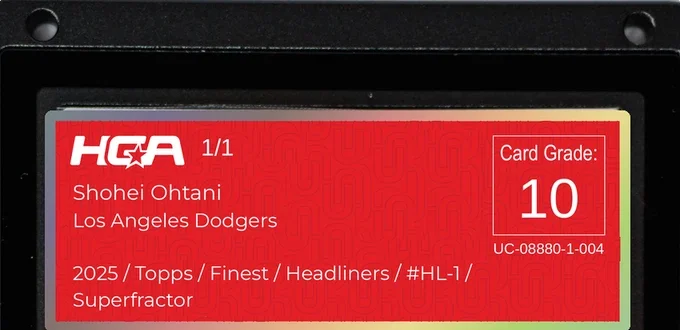 The label
- 01Every subgrade, explained
Each finding is placed on the card image with its severity, in plain words. Centering, corners, edges, surface, autograph.
- 02Every card, imaged
High-resolution scans of both faces, and the sealed slab, kept with the record.
- 03Public on the cert
The report opens from the cert lookup and from the card's entry in the pop report. It stays with the card in My Cards.
- 04Permanent record · NFT chip
Written to a record no one can alter, and tied to the NFT chip in the label, so a case or a label can be checked against the original.